
Flexible-load operator · New England
Compute as a controllable load. Heat recovered by design.
Entropy Mining develops and operates behind-the-meter bitcoin mining as a curtailable industrial load. The machines turn down when the grid needs room. The heat they make is captured for a building or process next door. Entropy Mining is the operator: it sites, builds, runs, and answers for the load.
- Site class
- 250 kW to 5 MW
- Load control
- Turndown in minutes
- Heat
- 40 to 60 °C loop
- Status
- Site development
connected load per site, design envelope
staged ramp, per-unit control, price or utility signal
most electrical input recovered as low-grade heat
first 1 MW pilot in progress, not yet energized
Heat is the product. Compute is the means.
01 / Approach
Three jobs, one operator
Most flexible-load projects fail in the seams: between the power study and the tariff, between the equipment and the building, between the promise and the meter. Entropy Mining holds all three jobs so nothing falls through.
-
Job 1
Site development
Power availability and service study. Tariff and supply structuring for interruptible or flexible service. Interconnection, permitting, and inspector coordination under the local building, electrical, fire, and plumbing codes. A written pathway before any equipment is ordered.
-
Job 2
Operations
Fleet procurement and commissioning. Sealed single-phase immersion cooling. Per-unit monitoring and control. A written curtailment playbook tied to price and utility signals. Maintenance, spares, and uptime discipline reported against the meter, not the pitch.
-
Job 3
Thermal integration
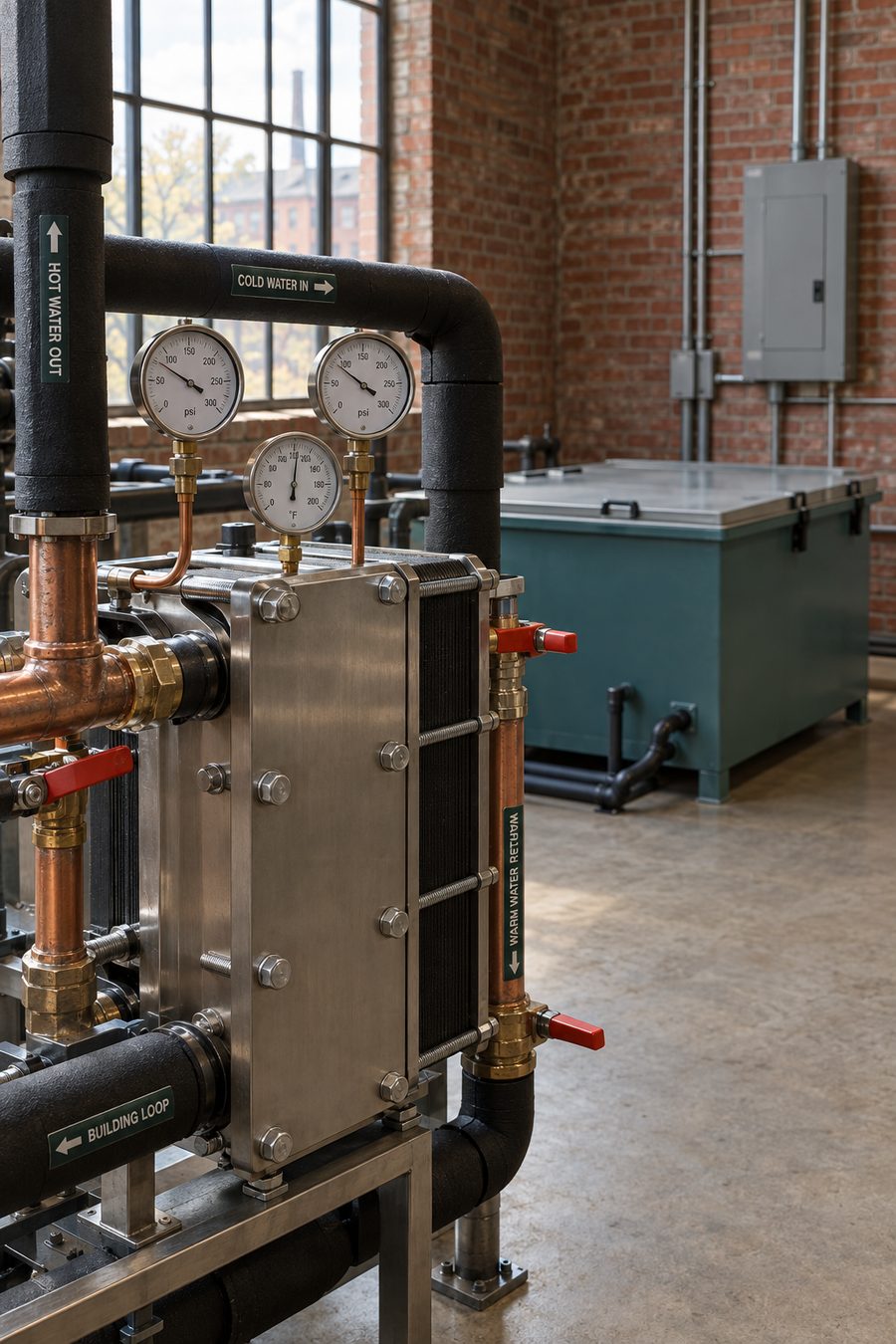
Plate heat exchanger to the host's hydronic or process loop. Metering on both sides. Heat delivered under an arm's-length agreement with the heat partner, so the host gets a priced, measured supply rather than a favor.
02 / How it works
One load in. Two useful outputs out. One signal that turns it down.
Every kilowatt of compute leaves as heat. Immersion cooling makes that heat easy to collect, and the machines can stop within minutes when the grid or the host needs the capacity back.
- Power comes in behind the meter on an interruptible or flexible tariff where one exists. The load is sized to the service, not the other way around.
- The load runs when it should. When power is cheap and the grid is easy, the fleet runs full. When price spikes or the utility calls, units step down and the whole site can be off in minutes.
- Hash rate leaves as revenue. The compute side carries the equipment cost and its own risk. That risk stays with Entropy Mining.
- Heat leaves as supply. Immersion fluid carries the heat to a plate exchanger; the host's loop takes it from there. Both sides are metered so the numbers can be audited.
03 / Design envelope
What a first-class site is built to do
These are the design targets for the first class of Entropy Mining sites. They set the conversation. Each site plugs into the existing electric and heat infrastructure on the host's property, building out only what a real evaluation shows is needed. Project-specific values come out of the site evaluation, with the assumptions written down.
| Parameter | Design basis |
|---|---|
| Site size | 250 kW to 5 MW connected load |
| Load control | Full turndown in under five minutes. Staged ramp. Per-unit control from price, utility, or host signal. |
| Cooling | Single-phase immersion in sealed tanks. Low noise. No evaporative water use. |
| Heat available | Most electrical input recovered as low-grade heat. Delivered fraction depends on host demand and season. |
| Loop temperature | 40 to 60 °C supply, matched to the host system. Not a substitute for high-temperature steam. |
| Interface | Plate heat exchanger to the building hydronic or process loop. Isolation on both sides. Metered both sides. |
| Telemetry | Per-unit power, fluid and loop temperatures, flow, and heat delivered. Logged and shareable with the utility and the heat partner. |
| Service | Behind the meter on an interruptible or flexible tariff where one exists. Coincident-peak avoidance is planned, not assumed. |
| Footprint | In-building mechanical room or a compact enclosure on the host's site, using existing service and building loop where present. No dedicated data-center shell; buildout is sized to the site. |
Values are design targets, not measured results. Measured results will be published here as sites are metered.
04 / Sites and partners
Where this fits, and who it is for
Entropy Mining is a small operator that chooses sites carefully. The best conversations start with a real service capacity number and a real heat demand.
What a good site has
- 250 kW or more of available service capacity, or a clear path to it
- A tariff or supply arrangement that rewards flexibility, or a utility willing to write one
- A heat sink within reach: a building loop, a process load, a greenhouse, a pool
- Room for sealed tanks, a heat exchanger, and a switchgear line-up
- An owner who wants a long-term operator, not a tenant who disappears
Who Entropy Mining works with
- Power producers with curtailed, stranded, or off-peak output
- Utilities and municipal light plants that want a load they can call down
- Owners of industrial and institutional property with steady heat demand
- Lenders and equipment finance partners who want to underwrite a metered load
- Equipment and service vendors: ASICs, immersion systems, switchgear, controls
05 / Heat
Heat is the product. Compute is the means.
Entropy Mining owns and operates the machines and carries the compute economics. The heat those machines make is assigned under arm's-length agreements to a heat partner, who delivers it to a building or process.
Where the host is a public building, the contracting party for heat is Entropy Energy Network, a separate organization organizing as a 501(c)(4). Entropy Mining does not contract with towns or schools for heat and does not speak for that organization. Keeping the roles separate is what lets a public host buy measured heat at a defensible price without taking on compute risk.
For private hosts, the heat agreement runs directly between Entropy Mining and the owner.
06 / Where things stand
What is true now, and what is proposed
Operators should be judged by meters, not by decks. Until there is a metered site, this page describes design intent and development work, and it says so.
- Design targets are labeled as targets
- Measured results get published when they exist
- Compute risk stays with Entropy Mining
Status
As of
- Entity
- Entropy Mining LLC, the operator lane of the Entropy family. Formation of the operating entity is in progress.
- Stage
- Site development. No Entropy Mining site is energized yet.
- First site
- A 1 MW immersion-cooled pilot in southeastern Massachusetts, in development. Service terms, permits, and heat agreements are in progress and not yet executed.
- Operating record
- No commercial operating history yet. Uptime, curtailment, and heat-delivery figures will be published here as sites are metered.
- Capital
- Nothing on this site is an offer of securities. Financing conversations happen by introduction, under NDA, with a written site evaluation in hand.
- Contact
- Site inquiries by email at mining@makeentropy.com.
Entropy Mining, Entropy Energy Network, and Entropy Foundation are separate organizations with separate governance. Agreements between them are priced at arm's length and documented.
07 / Thesis
Why an operator would bother
The operating case on this page stands on tariffs, meters, and heat. The longer argument for why proof-of-work belongs in the towns that industry left is a separate piece of writing, in its own lane, by the founder.
Read The Home FrontThe Home Front is the founder's thesis. It is an argument, not an offer, a forecast, or a statement by any other Entropy organization.
Digital warfare is the form. Hacking is the function. Bitcoin is the defense system. And the defense system pays the towns globalization forgot.
08 / Site evaluation
What the site evaluation covers
A site evaluation is the first deliverable. It is written so a utility engineer, a lender, and a building owner can each check the part that matters to them.
- 1
Power and tariff
Available service capacity, applicable tariff or supply terms, coincident-peak exposure, and the flexibility value on the table.
- 2
Load model
Fleet sizing, run-hour expectations, and curtailment scenarios under stated price and utility assumptions.
- 3
Thermal model
Host heat demand by season, deliverable heat, loop temperatures, and effective cost per unit of heat against the incumbent fuel.
- 4
Controls and safety
Turndown logic, isolation, fluid handling, monitoring, and the alarm and response plan.
- 5
Code and permit pathway
Building, electrical, fire, and plumbing requirements for the jurisdiction, and the sequence of approvals.
- 6
Economics
Capital, operating cost, revenue and heat value under stated assumptions, with the sensitivities that matter shown, not buried.
09 / Start with a site
Tell Entropy Mining about the power, the place, and the heat.
A service capacity number, a location, and a sense of the heat demand are enough to start. Replies come by email from the Entropy Mining team.
Messages are delivered by email to Entropy Mining and are used only to reply to the inquiry. See the privacy note.
Your message was received.
It has been logged for the Entropy Mining team and a reply will come by email within five business days.